
Impostor Syndrome: the problem isn’t doubt. It’s how you interpret it
Impostor syndrome is the experience of attributing your results to external factors: luck, chance, coincidence, while fearing that, sooner or later, you’ll be exposed as not good enough.
It’s not a clinical diagnosis.
It’s not a pathology.
It’s a very common psychological experience, especially in moments of growth, change, and exposure.
Most people don’t call it that.
But you can recognize it in thoughts like:
“I’ll be found out sooner or later.”
“I just got here by chance.”
“Everyone else is more prepared than I am.”
“I shouldn’t be the one doing this.”
Sometimes we don’t say it out loud.
But we think it while smiling.
We call it a “syndrome” because that’s the label that circulates.
But the name itself is misleading: it suggests something to eliminate, when often it would be more useful to pause and understand what it’s actually pointing to.
The issue isn’t that these thoughts exist.
The issue is what we make them mean.
A very common situation
You return to work after a break.
You step into a new role.
You join a course where everyone seems to already know everything.
You might think:
“Others seem to move more easily than I do.”
The quick interpretation is: impostor syndrome.
A more accurate one might be:
You’re learning.
You’re observing.
You’re finding your way in a new system.
The discomfort doesn’t come from incompetence.
It comes from the temporary gap between what you already know and what you feel you need to master to feel at ease.
Calling it a “syndrome” risks turning a natural transition into a personal flaw.
Misunderstanding #1: “If I feel this way, it must be true”
This is the most subtle trap.
In my coaching work, the feeling of “not being enough” almost never shows up in people who are truly unskilled or disengaged.
It shows up in people who:
care about standards
feel responsibility
want to do things well
are stepping into something new
Put simply:
real impostors rarely feel like impostors.
Those who are bluffing tend to overestimate themselves or protect their position.
Those who doubt are often doing something else: they are growing.
The problem begins when we turn a temporary feeling into a verdict about who we are.
Feeling out of place in a new phase doesn’t mean you are.
It means you are in the middle of it.
And the middle is uncomfortable.
But it’s not a flaw.
Misunderstanding #2: “It’s a women’s issue”
Historically, this experience was first observed in women.
But turning it into a “female problem” was a mistake.
Across thousands of coaching sessions, I see it everywhere:
women and men, junior and senior, people working inside and outside organizations, people changing roles, cities, or life phases.
Attributing it to a category has a serious side effect:
it shifts the focus from the environment to the individual.
As if the message were: work on yourself, because you are the problem.
Sometimes doubt is a reasonable response to:
unclear contexts
vague feedback with high expectations
environments where everyone seems to know, but little is actually clear
Not everything happens in the mind of the person who doubts.
Three practical shifts (to actually use)
1. Change the question
“Am I enough?” is a poor question. It’s abstract and has no stable answer.
Shift it to something observable:
“What have I learned or done today that I couldn’t do before?”
This question gives you progress, not judgment.
2. Make the hidden rule visible
Behind impostor thinking there’s almost always a silent rule:
I must be flawless
I must not show uncertainty
If I ask for help, I lose credibility
If I don’t know everything, I shouldn’t be here
Seeing it clearly is already half the work.
The other half is asking:
Is this rule helping me grow, or keeping me stuck?
3. Translate the fear
Fear isn’t the enemy. It’s information not yet decoded.
A simple question:
“If this wasn’t fear of being exposed, what else could it be, something positive?”
Often the answer is:
desire to do well
ambition
sense of responsibility
wanting to live up to something that matters
It’s not always a signal of inadequacy.
Sometimes it’s a signal of importance.
Something to take with you
Maybe the goal isn’t to “overcome” impostor syndrome.
Maybe it’s to stop using it as evidence against yourself.
Doubt is not a sentence.
It’s a passage.
Held in the right place, it becomes attention, depth, growth.
Mistaken for a verdict, it can make you step back at the exact moment you’re expanding.

You are okay
There is a kind of constant attention that accompanies many of our days.
Not because something is actually happening, but because the system is used to being that way.
You often feel it in the body before you notice it in your thoughts:
a tension that doesn’t quite release,
a breath that never really drops,
a subtle difficulty in fully resting into the moment.
Over time, this way of being becomes normal.
Tension doesn’t make noise. It doesn’t announce itself.
It settles quietly into the body, into the way we inhabit the world.
And at some point, we stop asking whether it’s even necessary.
Our brain is not designed to make us calm.
It is designed to keep us safe.
That’s why it maintains a background level of vigilance,
even when there is no immediate threat.
This function is useful.
It becomes exhausting when it never switches off.
Over time, it drains energy, makes stability harder to feel,
and creates that familiar sense of having to hold everything together,
even in moments that don’t actually require it.
This is where a simple—but not trivial—practice comes in:
noticing that, in this moment, you’re OK.
Not in an absolute sense.
Not because everything is working.
Not because life is easy.
But because, right now, there is something holding.
The body is doing its job, even when it’s tired, even when it’s repairing.
The breath arrives.
There is presence, even if it’s not continuous.
There is life, even if it’s imperfect.
It’s important to be clear: this is not a practice meant to deny pain.
There are moments—and for some people, long periods—when you are not “OK” at all.
Illness, loss, mental or physical exhaustion are real.
They are not crossed with a sentence.
In these cases, being “OK” doesn’t mean feeling well.
It means, when and if possible, recognizing a minimal point of support:
a breath that is still there,
a body that, despite the difficulty, continues to hold,
a moment that doesn’t ask to be fixed.
Training yourself to return to these micro-moments doesn’t change reality.
It changes how you move through it.
It’s a simple, concrete gesture.
A way to stop forcing—if only for a moment.
This practice doesn’t solve life.
It doesn’t fix what hurts.
It’s about noticing that, here and now, something holds.
Not because everything is fine.
Not because pain disappears.
But because, in this moment,
there is a point that holds.
You’re OK.
And you continue from there…
The Tribe of the Empathic
There’s a thought I often come back to.
If there were an empathy bingo card, and I counted how many times a day I hear someone describe themselves as “very empathic,” I would probably win quite often.
Empathy is one of those qualities people seem comfortable wearing. More comfortable, perhaps, than calling themselves intelligent. With empathy, we appear more generous with ourselves.
Over time, I’ve found myself pausing on this. Not out of judgment, but out of experience.
Because the more I work with people, the more I listen to their stories, the more empathy starts to look less obvious, less immediate, less simple than we often assume.
I don’t write this to define empathy. I write it to sit with it.
What I’ve learned is that empathy is rarely spontaneous. Our minds are built on shortcuts, categories, biases. They help us navigate the world. They are necessary. But they are also the very things that get in the way when we try to truly meet someone else.
Stepping into another person’s story requires intention. It asks us, at least for a moment, to loosen our grip on our own lenses. You can’t really enter someone else’s story while fully wearing your own.
Staying with another person’s emotional landscape is delicate work. It means resisting the pull to translate their experience into ours. It means noticing when familiar emotions get activated and choosing not to let them take over the space.
And this is where it often becomes tiring.
Almost without realizing it, we move toward advice, solutions, fixing. Those paths are reassuring. They give us something to do. Sometimes they soothe us more than they help the other person.
Being with someone else’s experience can hurt. It can touch unresolved places. It can make us feel powerless, or overly involved, or uncomfortable with not knowing what to do next. Remaining balanced inside another person’s story takes the presence of a tightrope walker.
Over time, I’ve come to see empathy less as resonance and more as hospitality.
Welcoming a story for what it is, without reshaping it. Even when it feels familiar. Even when parts of it echo our own. Another person’s story is not a mirror. It’s a window. And a window is something you approach with curiosity, not recognition.
This is perhaps why empathy feels so complex to me. And why I pause when I hear it claimed too easily.
We often confuse empathy with sensitivity, or with the sincere desire to understand others. A beautiful desire. But one that doesn’t always translate into being able to stay present.
Most of us know the feeling of not being truly listened to. Of being met with someone else’s story, or with advice we didn’t ask for. Many hands would go up. Expat life teaches this quickly.
In my work as a coach, I listen to many stories. Thousands of hours by now. And I’ve learned something simple and demanding at the same time: the moment I carry someone else’s story into my own, I make it harder to truly be there for them.
Empathy, at least as I experience it, asks for something paradoxical.
To forget my own story, rather than find it inside someone else’s.
Involvement is not empathy.
Presence, questions, and listening are.
Every story has its own gravity. It deserves care.
And perhaps the only real requirement is this: to leave our own shoes at the door.
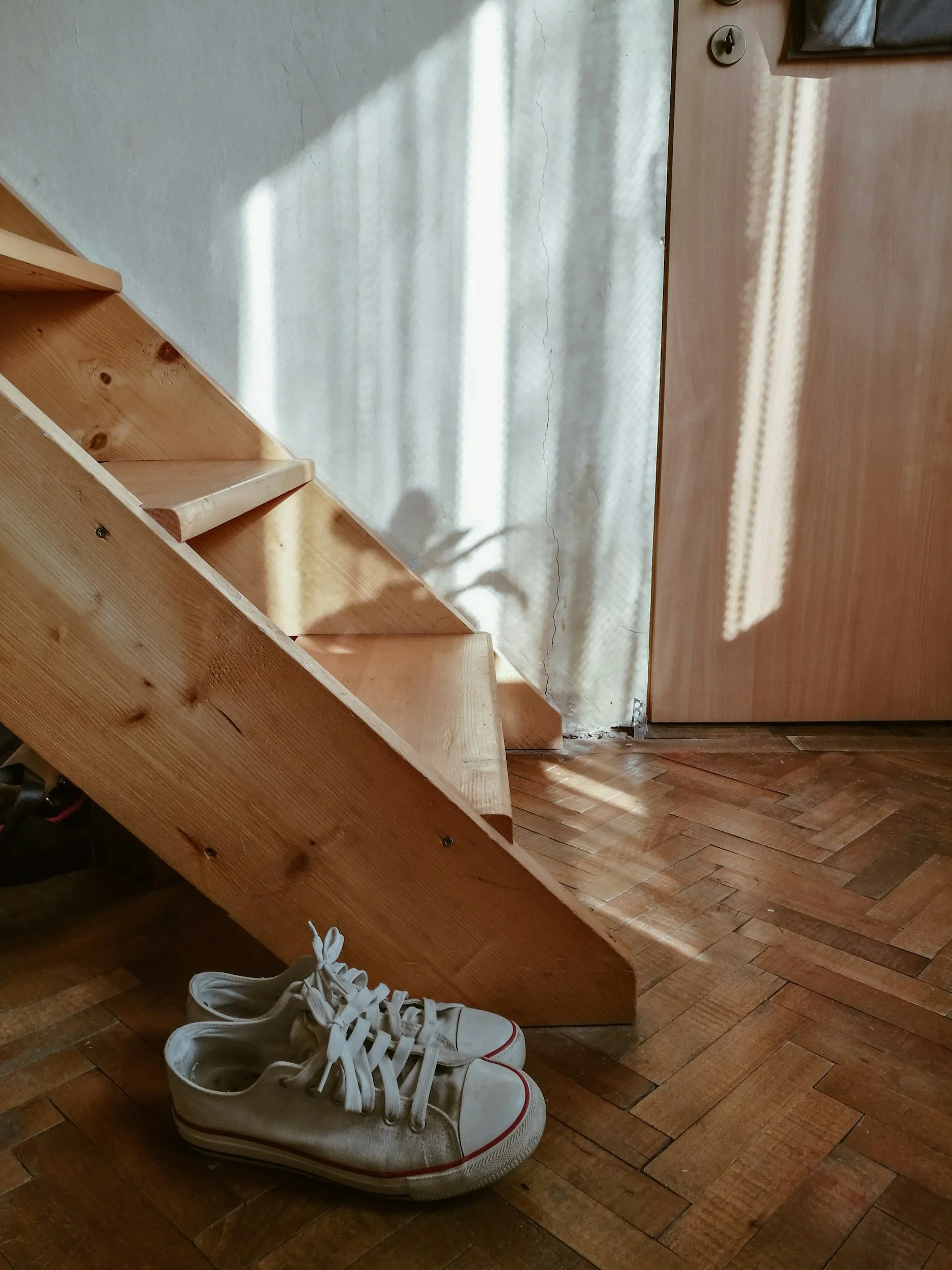
Leaving My Shoes at the Door
This space is an invitation to pause.
To leave assumptions, certainty, and quick answers at the door, and step into something a little more spacious.
Here, I write to reflect rather than to conclude. To stay with questions instead of rushing toward solutions.
Leaving My Shoes at the Door is a place for thoughts that emerge from listening, from being with people, from noticing what happens in the space between stories. It’s shaped by my work as a coach, by life lived across cultures, and by the quiet discipline of presence.
You won’t find instructions here.
What you may find are reflections meant to be held, not consumed. Words that don’t aim to convince, but to create room. For curiosity. For nuance. For being with others—and with ourselves—without needing to fix, explain, or perform.
This is a space to arrive lightly.
And to stay, just long enough.